
THIS PAGE IS UNDER CONSTRUCTION:
Pictures are being added as well as more information - however feel free to read what's here so far.  Thank you
 

THE HISTORIC WINDOWS

OF

EMMANUEL EPISCOPAL CHURCH


(excerpts from the booklet copyright 2008)


Emmanuel Episcopal Church
Description of windows

(Comments are in italics. Abbreviated sources are identified at end of list)


Over the entrance:
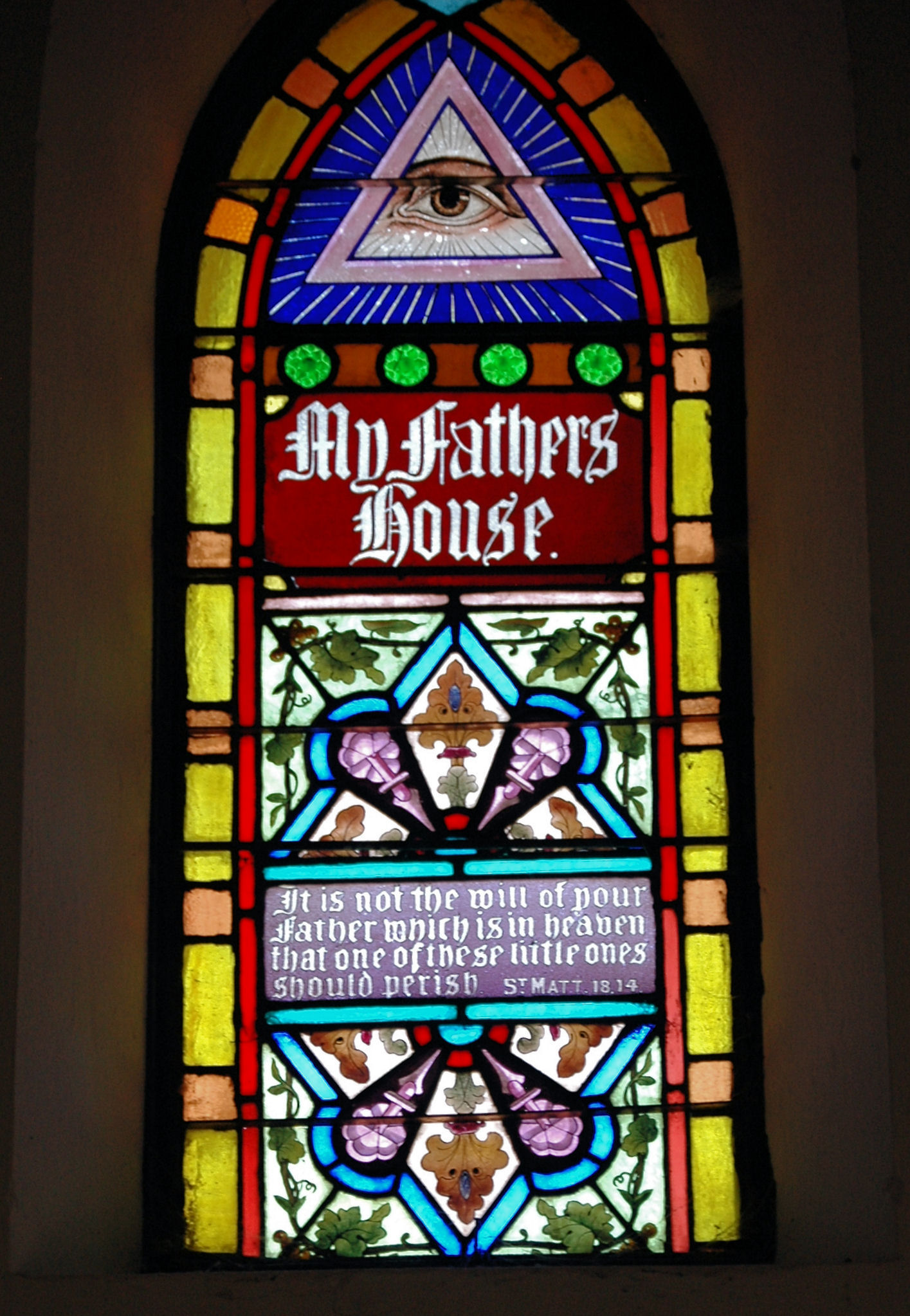
 

Top: the all seeing eye

My Father’s House

The "all-seeing eye" represents the all-knowing and ever-present God. During
the late Renaissance, the eye was pictured in a triangle with rays of light to represent the infinite holiness of the Trinity.(scaa) The all seeing eye also
appears on a one dollar bill.

Bottom:
It is not the will of your Father which is in heaven
that one of these little ones should perish. St. Matt. 18, 14 (kjv)


Left side, from entrance to altar:
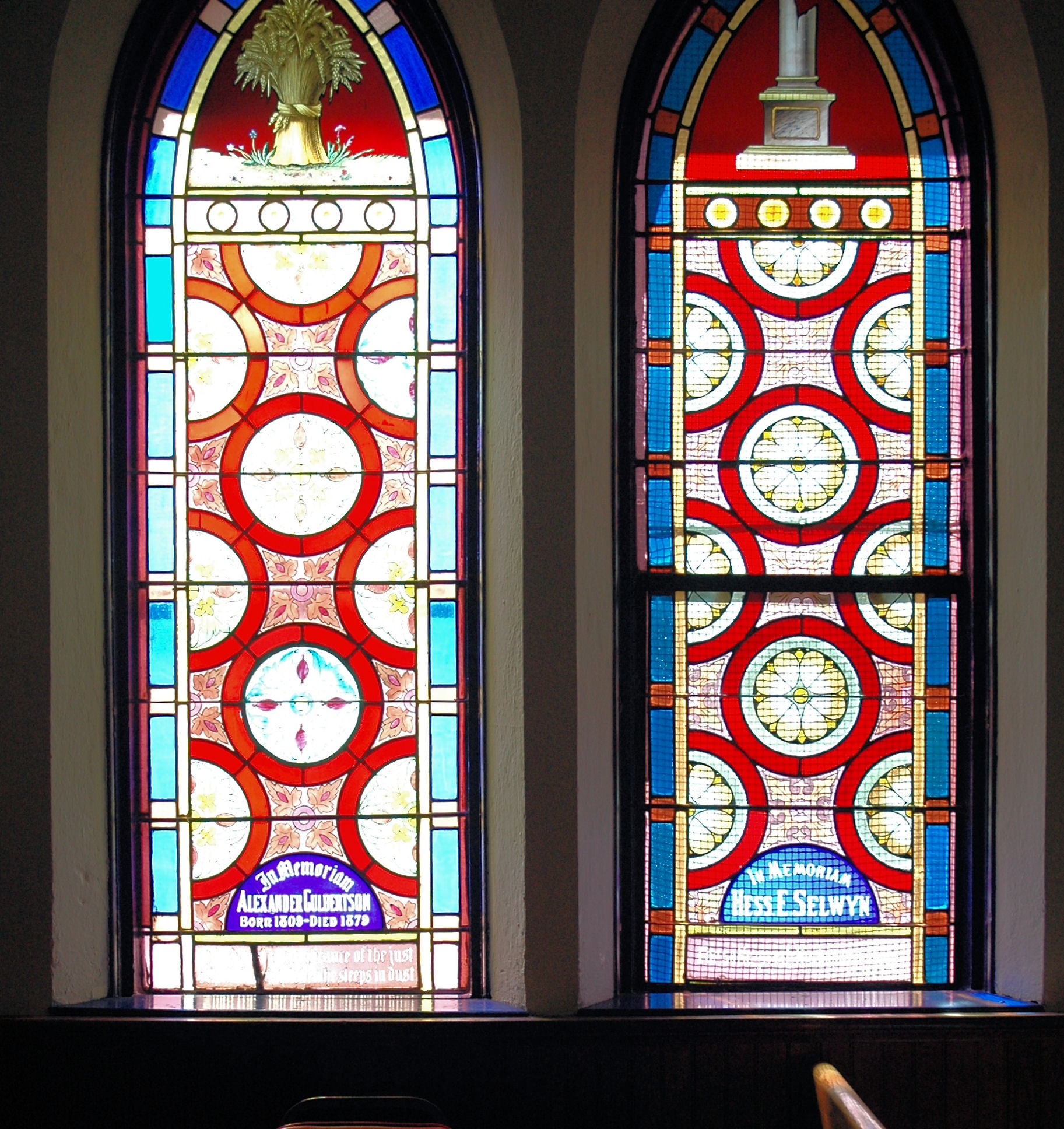

Top Left: Sheaf of wheat
Widely recognized as a symbol of the successful harvest, bounty of the earth “Wheat represents the harvest reaped from sowing the Gospel” (scaa)
Fr. Osborn, first priest of Emmanuel, “requested that at his funeral, a sheaf of wheat, symbolizing the garnering of the harvest, be placed on his casket.”(tey,p61)
At bottom:
In Memoriam
Alexander Culbertson
Born 1809 – Died 1879
“The sweet remembrance of the just
Shall flourish when he sleeps in dust”

Alexander Culbertson represented the American Fur Company
in the Upper Missouri River Basin beginning in 1833.
He established Fort Benton, the first permanent settlement in Montana in 1847.
With his wife Na-Ta-Wis-Cha, a Blackfoot Indian, he helped the Government as interpreter and guide in making treaties with the Indians.
He blazed trails which were followed by settlers and are now routes of highways.
His daughter Julia Culbertson Roberts and her husband George H. Roberts
were affiliated with Emmanuel in the late 1880’s.
Top Right: broken column
Used as a gravestone symbol to denote a life cut short.
Sometimes found marking the grave of a child or young person.
The definition for Broken Column in the Pocket Lexicon of Freemasonry is
“emblematic of the chief supporter of the Craft, who fell before his work was quite complete.”
It may be found on gravestones to symbolize when a firm supporter of right and good has perished.

At bottom:
In memoriam
Hess. E. Selwyn
For so He giveth His beloved sleep Ps 127.3
(Coverdale’s translation of the Bible)
Mr. C. J. Selwyn participated in the presentation of a drama entitled, “Aunt Jerusha’s Mistake; or Too Clever By Half” presented as a church activity on October 28, 1886 (tey p.44). C. J. Selwyn is mentioned in the Wood River Times, November 17, 1886, when his vote was protested against on the ground that he was not a citizen of the United States. Perhaps C. J. Selwyn was the donor for this window.
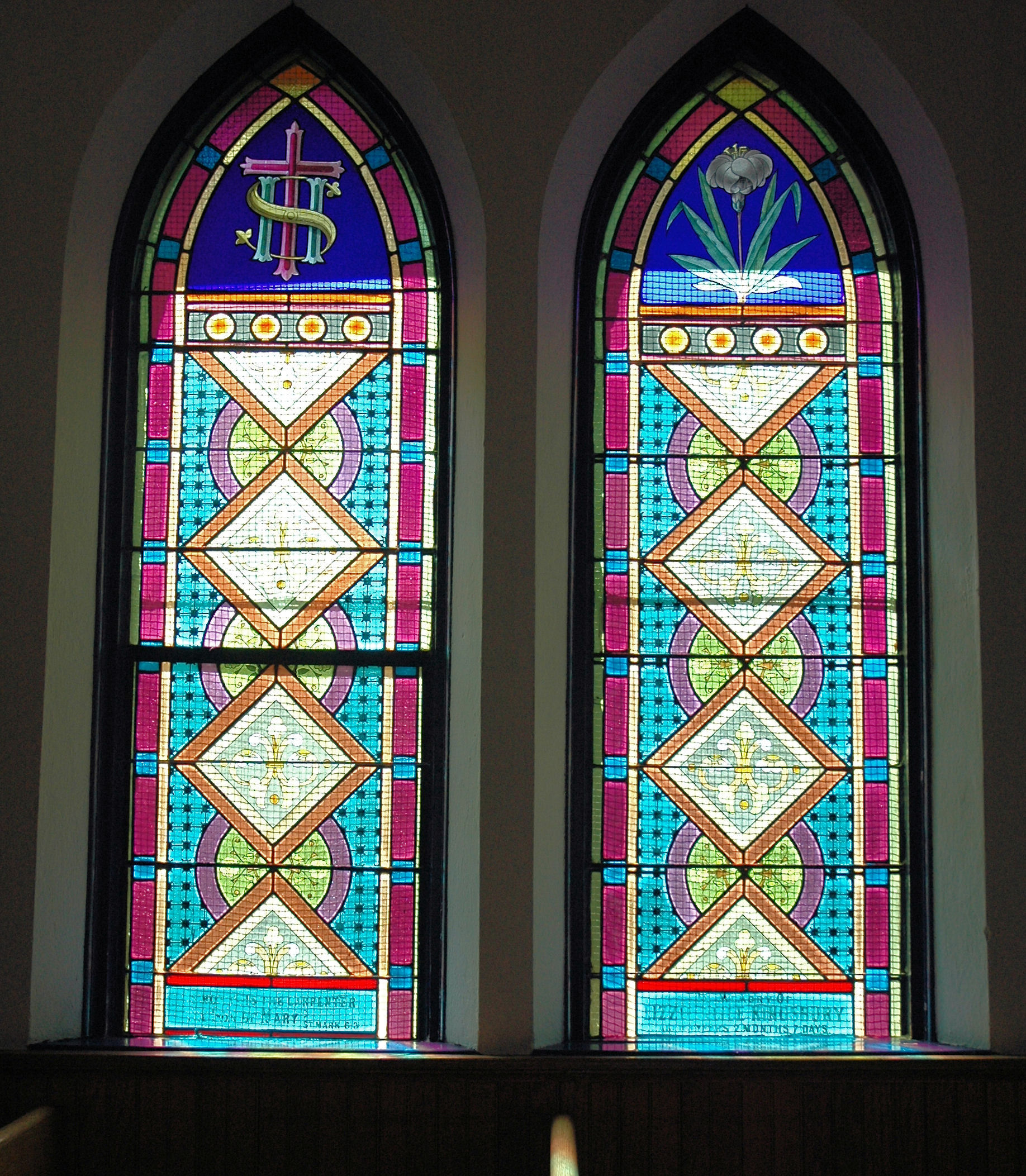

Left Top: IHS 
A version of the sacred monogram, formed from the first three letters of the Greek word for “Jesus” (IHΣOYΣ)
The horizontal line that forms the cross is the sign for an abbreviation.
The liliform end caps are suggestive of the trinity and known as “fleurie.” (scaa).
At bottom:
Is not this the carpenter, the Son of Mary? St. Mark 6.3

Top Right: Lily
The lily is a symbol of purity and has become a symbol of the Virgin Mary.
The Easter lily, a particular variety which blooms in the spring
from a seemingly lifeless bulb, has become symbolic of Christ’s Resurrection.
A lily blooming among thorns has been used to represent the Immaculate Conception.
A lily can also be used as a symbol for Christ. (scaa)

At bottom: 
In memory of
Lizzie Alice Kingsbury
Aged 3 years 2 months 7 days
“She was the first child of Selden and Hulda Kingsbury, and was buried in Menton, Ohio, before the Kingsburys moved to Hailey (tey p.33)  On October 1, 1883; Hailey became the first town in the Idaho Territory to have a telephone system. The first operator was 12 year-old Nathan Kingsbury, Lizzie’s brother. (tey 12)  In 1913, as Vice President of AT&T, Nathan Kingsbury authored an agreement with the government to settle antitrust disputes. This agreement is known as the Kingsbury Commitment.


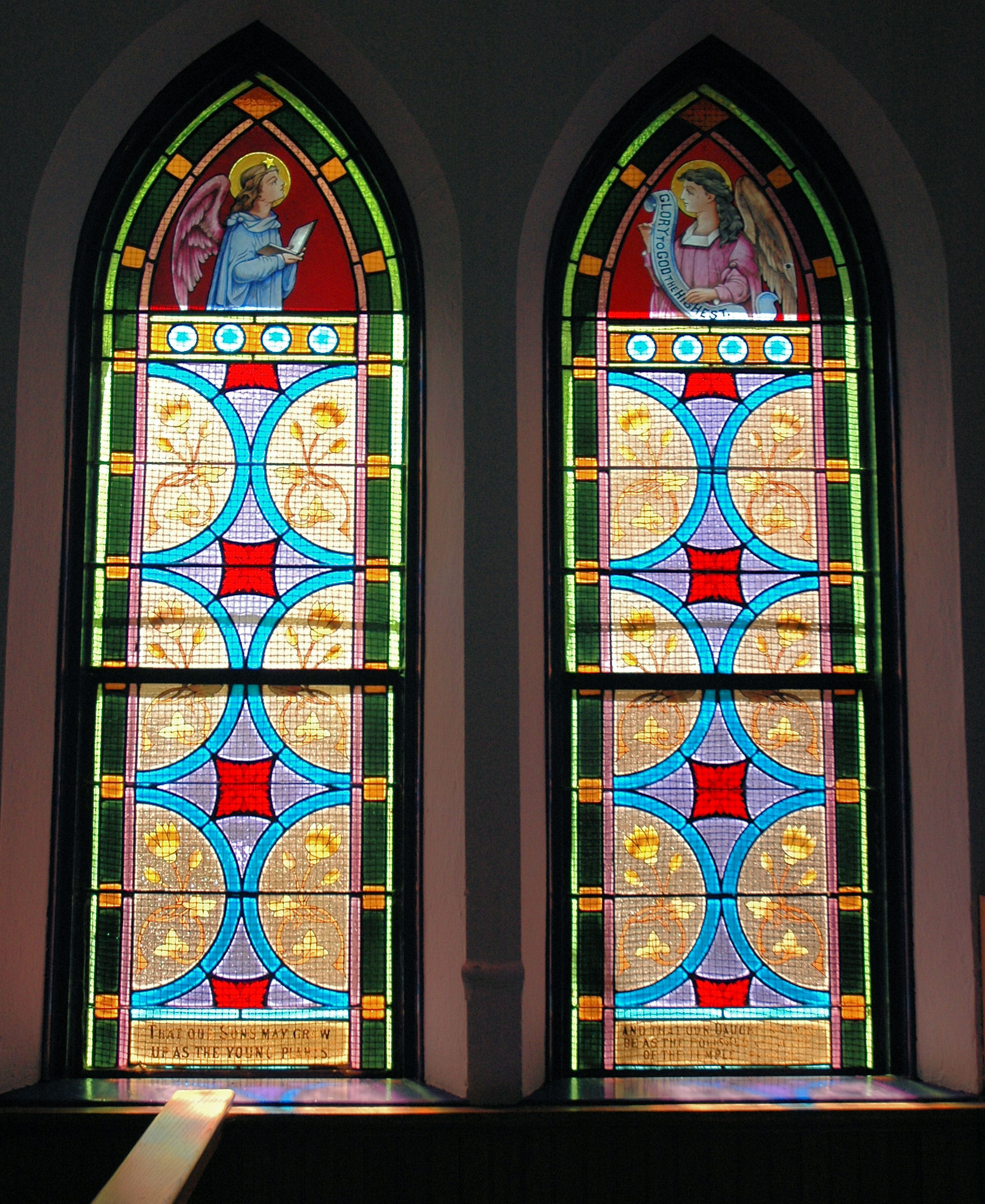
Top Left: Angel holding open book.
An angel is a spiritual being created by God to be his agent and do his will. In scripture, angels protect, heal, lead, intercede and execute judgment. (www) A book most commonly represents the Word of God, the Bible. An open book represents truth or revelation. (scaa)

At bottom
“That our sons may grow up as the young plants" (note: continues on next window)

Right Top: Angel holding banner “Glory to God in the Highest
The banner is a symbol of victory (scaa) the message on the banner is that of the heavenly host praising God at the birth of Christ. (kjv John 2:14)


At bottom
"And that our daughters may be as the polished corners of the temple.” Psalm 145, 12
Text appearing on these two windows is the exact wording of
Psalm 144, 12 Coverdale’s Translation of the Bible


Facing the altar, from the left:


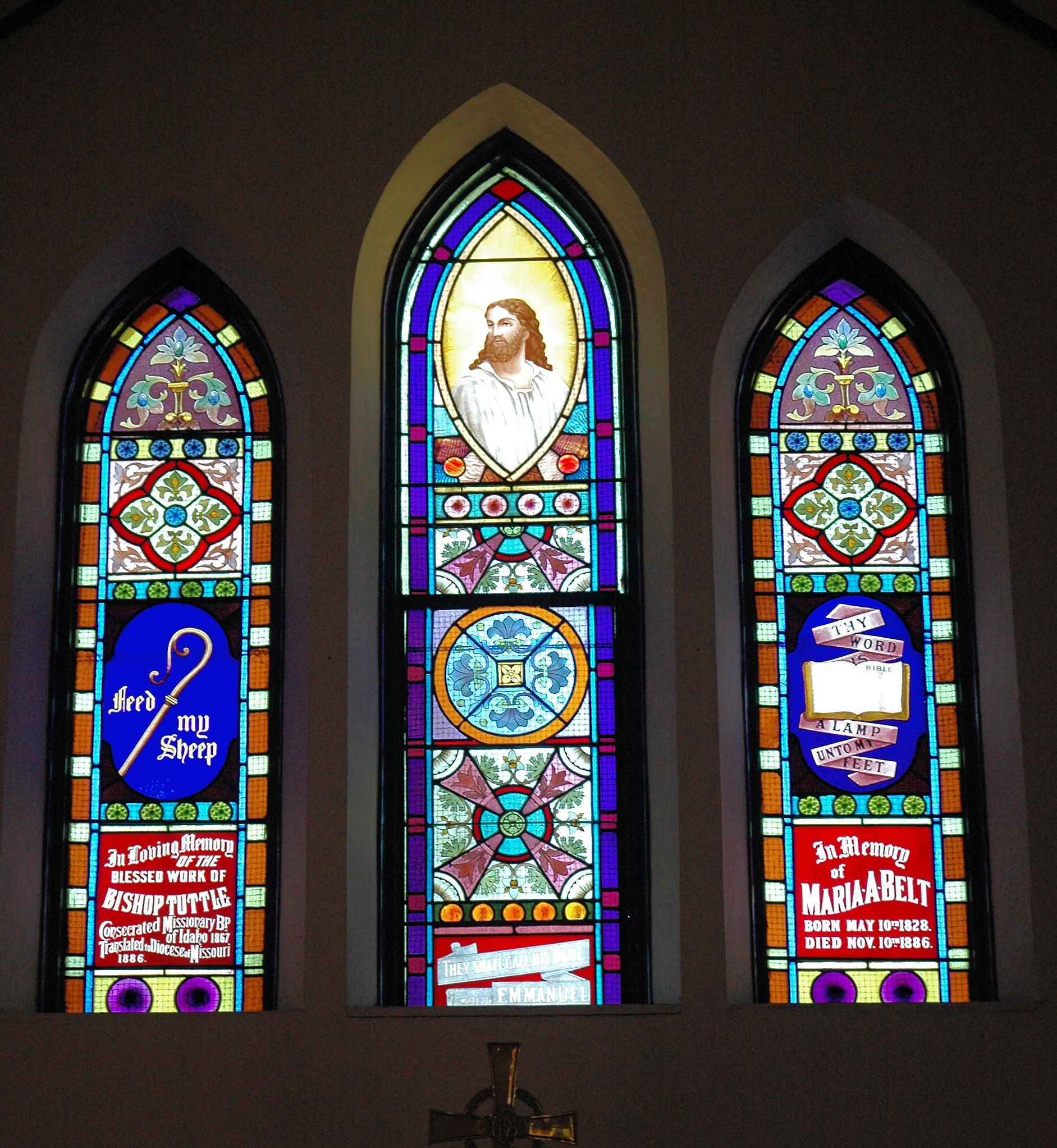
Left Center: crook, with “Feed My Sheep”
“The shepherd’s crook is a reminder of Jesus, the Good Shepherd” (scaa)” When Jesus appears to his disciples he says to Peter “Feed my Sheep.” (kjv St. John 21:17)
“The crosier, a pastoral staff of wood or precious metal, shaped like shepherd’s crook;
carried by bishops and abbots as a sign of the bishop’s pastoral role and the ecclesiastical authority they exercise over their flock.” (www)
At bottom
In loving memory of the Blessed work of Bishop Tuttle
Consecrated Missionary Bp
Of Idaho 1867
Translated to Diocese of Missouri 1886
John Sylvester Tuttle was born January 26, 1837 and died April 17, 1923. As senior bishop in order of consecration, he served as Presiding Bishop from 1903 to 1923. (Wikipedia) He authored "Missionary to the Mountain West, Remembrances of Episcopal Bishop Daniel S. Tuttle 1866-1886 reprinted in 1987 by the University of Utah Press, ISBN 0-87480-305-5

Center Panel Top: Portrait of Christ (head and shoulders)
He is shown with brown curly hair and beard, wearing a white robe. The portrait is sent in a radiant “elongated aureole, known as a mandorla, which is a symbol of divinity and supreme power.” (scaa)

Center Panel Bottom, a banner proclaiming
"They Shall Call his Name Emmanuel" St. Matthew 1, 23
Behold, a virgin shall be with child, and shall bring forth a son, and they shall call his name
Emmanuel, which being interpreted is, God with us.” (kjv)
Right: open Holy Bible
A lamp unto my feet
A book most commonly represents the Word of God, the Bible.
An open book represents truth or revelation.” (scaa)
Psalm 119:105 “Thy word is a lamp unto my feet, and a light unto my path.” (kjv)
At bottom Right:
In memory of
Maria-A-Belt  Born May 10, 1828  Died Nov. 10, 1886
This window “was given in memory of Marie Belt or ‘Grand’ma Belt’ as she was affectionately called by all who knew her.
She was the mother of Mrs. Joseph K. Morrill and grandmother of Mrs. William H. Greenhow of Ketchum.
She died on November 10, 1886, at the age of 58.
The funeral service took place at the Morrill residence, with Fr. Osborn officiating.” (tey p.33)
For the “Vanity Fair”
( held by the ladies of the church to raise money to help with the construction of the church) “Mrs. M. A. Belt took on the tedious task of
knitting three pairs of gentlemen’s silk socks for the occasion.” (tey p7)

 
Right side, from altar to rear

Top Left: anchor entwined with lanyard
The top part of the anchor is shaped like a cross. The cross symbolizes redemption, with Christ risen from the dead and reigning from the throne in heaven. (www)
The anchor symbolizes the Christian’s hope in Christ. It suggests the end of our voyage and indicates that we have weathered the storm and reached a safe harbor in Christ. (mw).
The anchor is a Christian symbol for hope and steadfastness. “Which hope we have as an anchor for the soul, both sure and stedfast,
and which entereth into that within the veil. (Hebrews 6:19 kjv)

At Bottom Left:
Clara May Osborn
Died Jan 3rd 1881
Aged 11 months
“They shall be mine saith the Lord of Hosts in that day when I make up my jewels.” Mal. 3.17 (Malachi 3:17) The first priest at Emmanuel was The Rev. Israel Tremain Osborn. His ministry began in January 1883. “On January 3, 1881, The Osborn’s first and only daughter, Clara May, died a month short of her first birthday. During the next few months Fr. Osborn
volunteered for missionary work in Idaho under Bishop Tuttle”. (tey p 3)
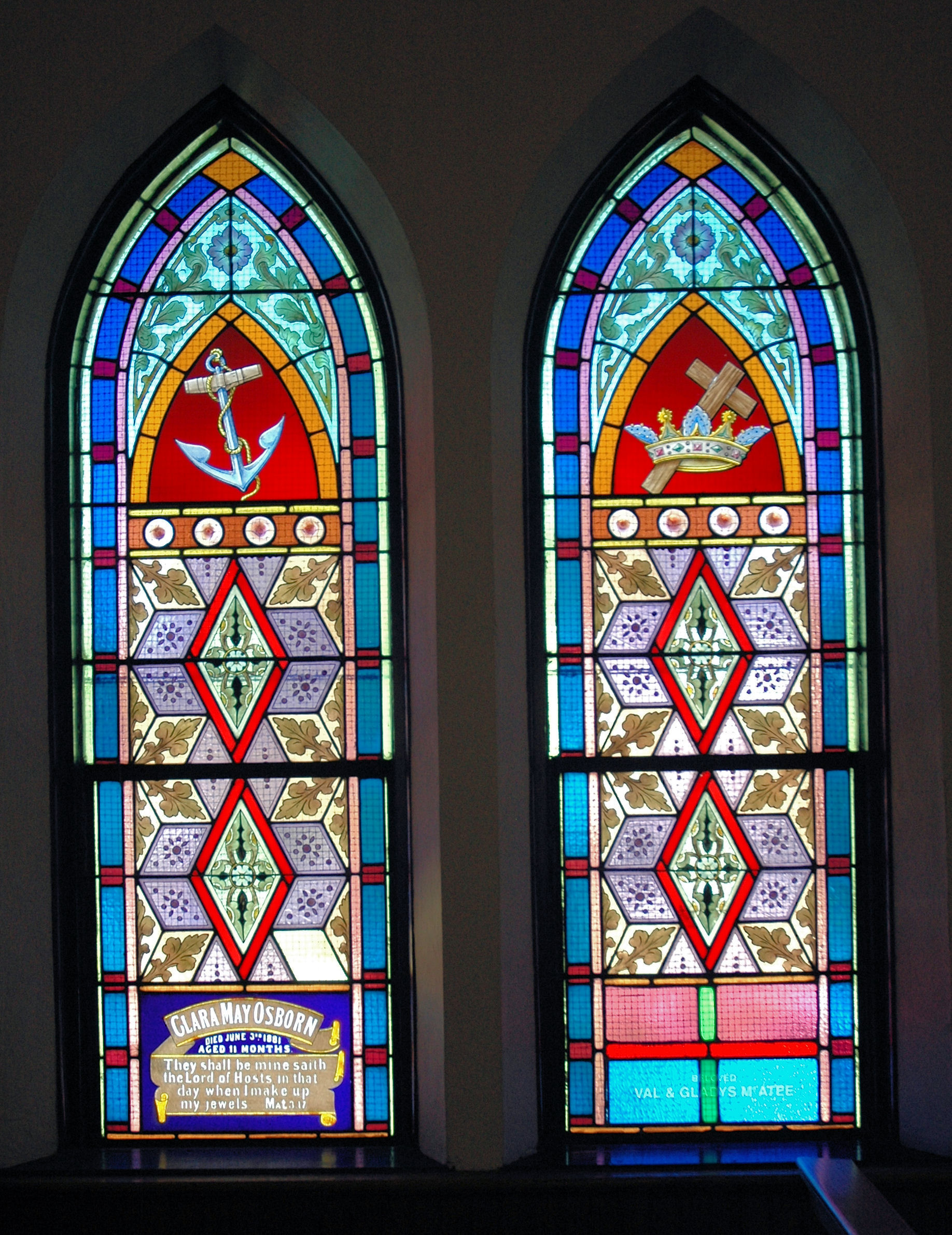

Top: cross in a crown
The cross has become the mark or sign of the Christian religion, the emblem of atonement, and the symbol of salvation and redemption. (ssci)
A cross surrounded by a crown symbolizes the reward awaiting the faithful after death. (www) “Be thou faithful unto death, and I will give thee a crown of life.” Rev.2:10 (kjv)
And when the chief shepherd shall appear,
ye shall receive a crown of glory that fadeth not away 1 Peter 5:4 (kjv)
At bottom
Val & Gladys McAtee
Parents of Marilyn Shilue.


Top Right: lamb
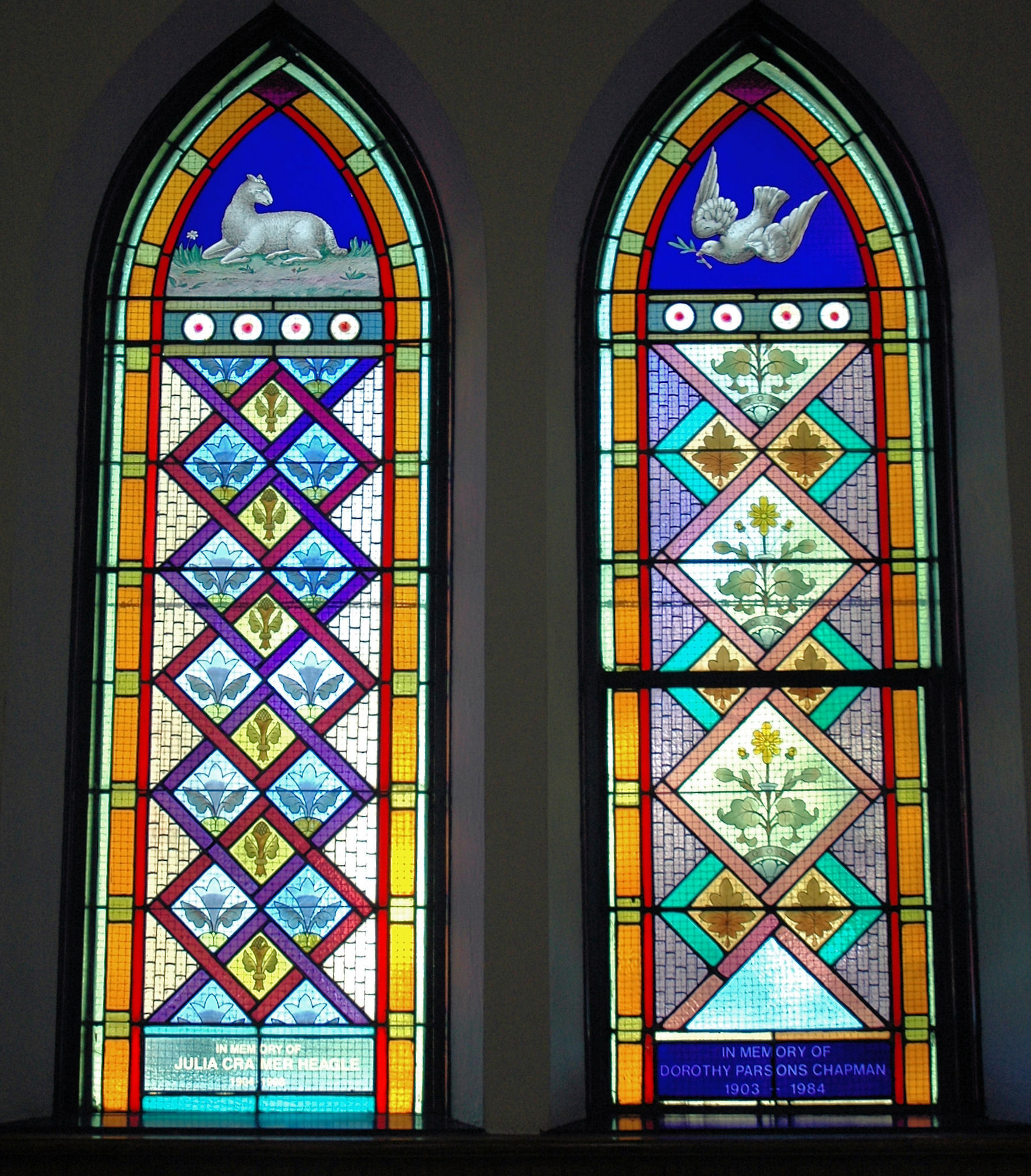

A symbol for Christ. In Bethany, beyond Jordan, where John was baptizing, “John seeth Jesus coming unto him and saith, ‘behold
the Lamb of God, which taketh away the sin of the world.’” St. John 1:29 (kjv)

At bottom Left:
In Memory of
Julia Cramer Heagle
1904-1998
Mother of Lois Jean Heagle


Top Right: dove with olive leaf
“The dove and olive leaf symbolize hope and God’s enduring love for his creation.” (mw)
And the dove came in to him in the evening, and lo, in her mouth was an olive leaf plucked off: so Noah knew that the waters were abated from off the earth.” Genesis 8:16 (kjv)

Bottom Right:
In Memory
Dorothy Parsons Chapman 1903 – 1984
Mother of John Chapman
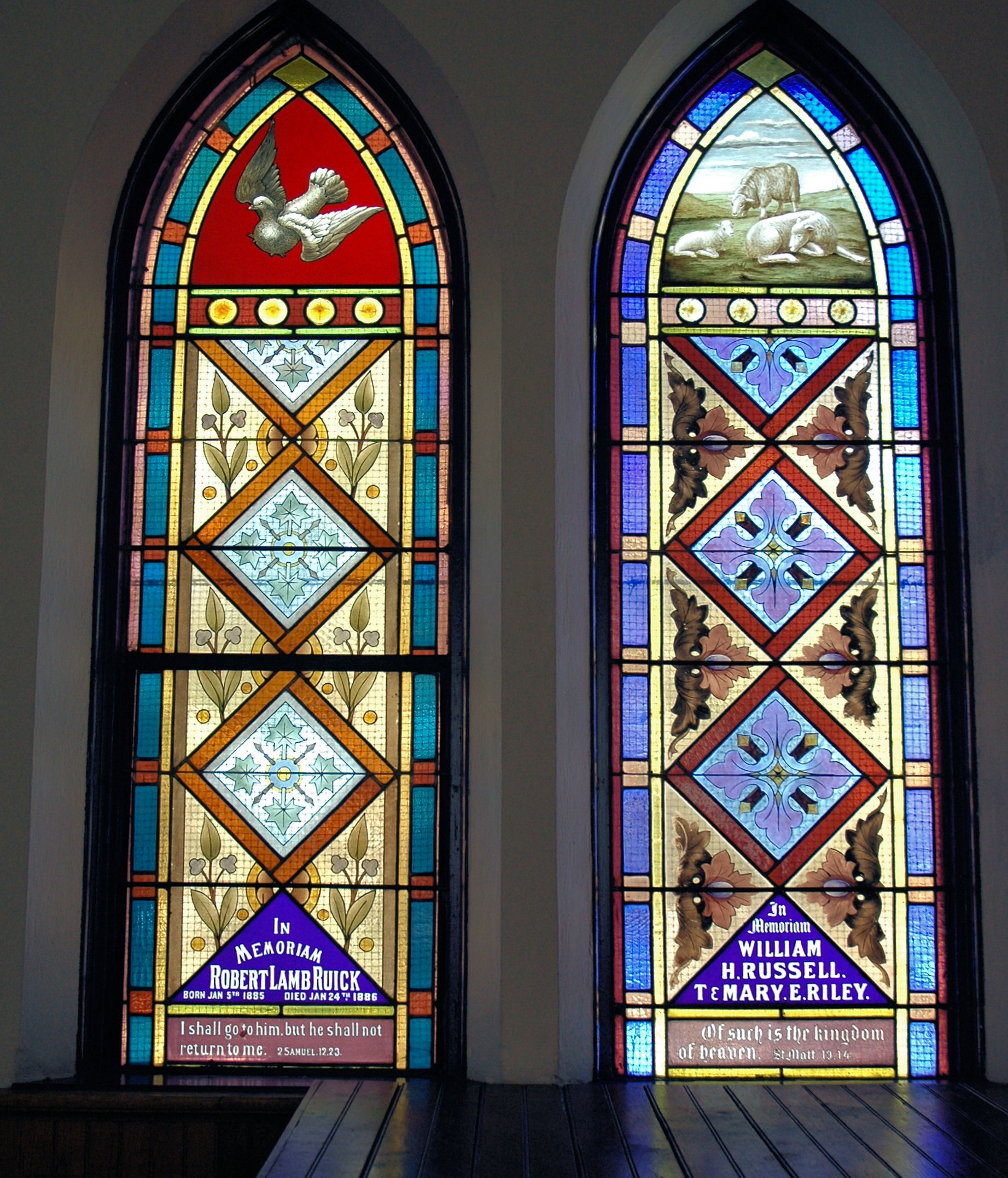


Top: dove in flight, against red background.
Red is the color for the Holy Spirit. “The dove is a symbol of the Holy Spirit. It is taken from the story of Jesus baptism, where the Spirit descended on him in the form of a dove.” scaa

Bottom
In Memory of Robert Lamb Ruick
Born Jan 5th 1885 Died Jan 24 1886
“I shall go to him but he shall not return to me” 2 Samuel 12.23
“Robert Lamb Ruick, the year-old son of Mr. N. M. Ruick, a District Attorney, and Julia D. Ruick. Robert died on January 24, 1886, in Los Angeles, of congestion of the brain.” The funeral took place on the afternoon of February 3 at the church.” (tey p.32)

Top: 3 sheep
“So we thy people and sheep of thy pasture will give thee thanks for ever: we will shew forth thy praise to all generations.” Psalm 79:13 (kjv)
 
Bottom
In memory of
William H. Russell
T & Mary Riley
St. Matt 13.14
And in them is fulfilled the prophecy of Ê-şâ’ias, (Isaiah) which saith, By hearing ye shall hear, and shall not understand; and seeing ye shall see, and shall not perceive (kjv)
W. T. (William Tecumseh) Riley is listed as a member of the 1883 church committee meeting with Bishop Tuttle to select Emmanuel as the name for our church. (tey, p9)
He was stage agent for the U. I. & O. Stage Company, a friend of Bishop Tuttle who knew him in Kelton, Utah, and one of the group who had the town site surveyed in 1881.
In 1882 he lived across the street from Emmanuel,
on the property now occupied by the Masonic Hall. (tey 10)
Perhaps the people named on this window were his relatives. .
See next page for identification of abbreviated sources


NEW PEOPLE OF THE WINDOWS
EMMANUEL EPISCOPAL CHURCH 

VAL & GLADYS McATEE
( entered September 10, 2008)
Val and Gladys McAtee came to the Wood River Valley in 1936. He began working for Union Pacific in Shoshone in 1935 and retired in 1973. Their life is entwined with the story of the first destination ski resort in the United States, the first chair lift in the world, the arrival of a new wave of development and growth and prosperity to the slumbering site of a 19th century brief mining bonanza. Val worked on the building of the lodge, the construction of the ski lifts and then transferred to maintenance in the lodge and inn.
Val, at the request of The Rev. Doug Ellway (1954-1973) started out to “fix the floor” in the basement at Emmanuel. As such projects frequently do, this one turned into: replace the floor, close 2 windows and a door, put up studding for new walls, drop the ceiling, finish work as needed and painting; finding helpers and specialists as needed. Val was a good steward of our beloved building and also found time to serve on the vestry and assist with other activities.
In addition to helping the church ladies with their fund raising, social activities and all the tasks associated with caring for our building and congregation, Gladys also sang in the choir for many years. She was gifted at needlework and made many of the altar hangings and vestments. She was a wonderful and inspired cook who continued to bring good things to eat to Emmanuel for all of her long life.
Val and Gladys McAtee were married on December 7, 1931 at Saguache, Colorado and enjoyed a marriage that endured for 72 years. To this union were born 3 children, Wayne, Marilyn and Kent. Their daughter, Marilyn Shilue, is currently a member of our congregation. For a few years the family lived in Ketchum when the town was almost entirely populated by Union Pacific employees. It was at St. Thomas where their children were baptized by The Rt. Rev. Frank A. Rhea during a time when the Wood River Valley was without a resident priest. Later the McAtees moved to an acreage south of Hailey where Friedman Airport is now located. In the 1960’s they acquired and developed property 5 miles out Croy Canyon.
Wyatt Val McAtee was born February 14, 1910 at Leonard, Oklahoma. His parents were Wyatt I. McAtee and Idabell Colman McAtee. Val died October 31, 2003 at his home in Hailey. His services were held at Emmanuel. Val’s Grandmother was the first to live in the Wood River Valley. She lived on Poverty Flats, near Bellevue, Idaho. She died of a tick bite and the resulting Rocky Mountain Spotted Fever. Her services were conducted at Emmanuel in 1913 by the Rev. R. R. Springfield , Priest (June 12, 1912-1914.)
Mary Gladys Smith was born on March 14, 1914 in Center Colorado. She was the second youngest of 11 children born to John and Viola Smith. She died on December 16, 2006 at her home in Hailey. A memorial service was held at Emmanuel on December 28, 2006 with inurnment at the Hailey Cemetery on May 19, 2007.
JULIA CRAMER HEAGLE
(entered September 10, 2008)
During much of the 20th Century, Hailey was a sleepy little town with a colorful 19th Century past.  Emmanuel’s long history as a faith community was made possible by the dedicated volunteerism of many lay members such as Julia Cramer Heagle.
The women of the church were always looking for ways to make money to keep the church operating.  One activity was called “Merchant’s Lunch.”  About 1964 Julia decided these lunches did not generate an adequate return for the investment of the time to cook and serve and the cost of the food.  Her replacement project adopted by the women of the church was the Thrift Store, still in operation.  Into the 21st Century the Thrift Store has generated significant funding for balancing of our budget.   Its first home was the annex that was formerly attached at the back entrance to the church.  The present building was purchased in 1969.   Julia’s daughter, Loma Hill, recalls helping her mother sort and price the donated items for many hours, weekend after weekend.   Numerous volunteers have donated countless hours and tons of items to this project.
Julia’s grandparents were Ernest C. (1836-1916) and Charlotte (1844-1914) Cramer.  In 1881 they built the first log cabin in Hailey.  Ernest was an early merchant.  They were members of Emmanuel. Their children were Julia’s father Hugh, Leo, John, Louise and Ottilia. Their daughter was singing at church activities as early as 1885.  Fr. Osborn performed the marriage ceremonies of four of their children.
Hugh Cramer was an early postmaster at Hailey.  He married Ida Haupt, one of five members in the Hailey graduating class of 1899.  The graduation ceremony was held in the building that now houses the museum.  Julia Cramer Heagle was their daughter.
Julia Cramer was born in 1904.  She graduated from Hailey High School in 1921.  After attending Albion Teacher’s College she taught for two years.  While teaching in Bellevue, one student was Jack Davies also a long-time member of Emmanuel and father of Laren Price who is currently a member of Emmanuel.  In 1925 Julia married Lawrence Heagle, also a graduate of Hailey High School, class of 1921.   The marriage ceremony was performed by The Rev. W. S. Dumvil of Shoshone.  Their marriage flourished for 69 years.  Their children are Loma Hill and Lois Jean Heagle, a current member of the congregation.
 Julia Cramer Heagle was an active member of her P.E.O. group.  The Blaine County Historical Museum was the idea of Julia and Ann Vancil Dunn.  They inspired many residents to assist with collecting and preserving the history of the county.  Julia Cramer lived in Hailey all of her life.  She died in 1998.
Lawrence Heagle was the Ford Dealer for Blaine County and also held a variety of county and state elective offices.  While Idaho’s representative to the National Automobile Dealers Association, he and his wife enjoyed lots of world travel.  He died in 1994.

DOROTHY PARSONS CHAPMAN
(entered September 10, 2008) 

In 1941 Marshall Byron Chapman and Dorothy Parsons Chapman purchased the Cloverly Ranch property from the family of The Rev.  I. T. Osborn, first priest at Emmanuel.  While living in Twin Falls, the Chapmans and their son John Sherwood spent a great deal of time, including most weekends, at Cloverly Ranch and Dorothy became an active and loyal member of Emmanuel Church.
Dorothy was the historian for the church and wrote a history of Emmanuel Church. As chairman of the Centennial Committee she researched the contents of the corner stone.  A number of events were scheduled, including an ice cream social to take place at Cloverly Ranch.   Unfortunately, Dorothy Parsons Chapman died on April 2, 1984.  She left money in her will for the celebration and the ice cream social was held at the Cloverly Ranch in her honor.   
 
Dorothy=s son, John Sherwood Chapman, (Born July 6, 1936) worships regularly at Emmanuel and lives at Cloverly Ranch.  He has carefully and skillfully restored and improved the property where he frequently hosts special events for the congregation
 
Dorothy Parsons was born February 28, 1903 in Detroit Michigan.  Her parents were Lafayette Russell (Beede) Parsons and Florence McCormack Parsons.  In 1906 the family settled in Moscow, Idaho because the University of Idaho was there and Lafayette had been employed to manage the Musselshell Mining & Timber Company near Pierce and Weippe, Idaho.  Dorothy had six siblings and their father wanted them all to have a college education.  The Parsons were staunch Episcopalians, Dorothy was baptized and confirmed by the priest in Moscow, and was a dedicated Episcopalian all her life.  Dorothy graduated from the University of Idaho in 1926 with a degree in Physical Education.  She became a P.E. teacher, first at Idaho Falls later in Twin Falls. 
 
On July 2, 1934 Dorothy Parsons married Marshall Byron Chapman at St. Michael=s Cathedral in Boise, Idaho.   The Rt. Rev. Frank A. Rhea, Bishop of Idaho (1942-1957) officiated. 
 
Marshall Byron Chapman was eight years old when his family moved to Hailey, Idaho in 1908.  The Chapman=s joined Emmanuel Episcopal Church and participated in the activities of the Church.  In 1918 Marshall Chapman was hired by the District Court Judge, Francis Ensign, to be his court reporter.  Marshall Chapman was very active in community affairs in Hailey.  He joined the Masonic Lodge in Hailey and became the Commander of the Hailey American Legion. In 1928, after reading law with Judge Ensign and Judge Sutphan, Marshall passed the bar exam and became an attorney. He then joined his brother, W. Orr Chapman in a law partnership in Twin Falls, known as Chapman and Chapman. Marshall loved to hut and fish.  He especially loved to fish on the Wood River, particularly on the stretch of the river owned by I. T. Osborn, the first priest of Emmanuel Church.   
 
 
Marshall Byron Chapman was a member of a prominent Idaho Pioneer Family.  His father, John William Chapman came to Boise, Idaho in 1864 by wagon train from St. Louis on the Oregon Trail.  He had been wounded in the Civil War and Union soldiers had burned down his family=s home.  When he learned that gold was discovered in Idaho City, he came west to seek his fortune.  He later followed the gold rush to Montana where he married Katie Orr.  Katie Orr was the daughter of Sample Orr who had left Missouri and took his family on the steamboat up the Missouri River to Ft. Benton, Montana.   In 1908, John William Chapman moved with his family to Hailey, Idaho where their son William Orr Chapman had been hired as a court reporter for the District Court Judge, James Bothwell. 

SOURCES:

Holy Bible, King James Version

International Standard Cersion of the Holy Bible, 2008

The Book of Common Prayer, 1789 and 1928

Frontier Diplomatic Alexander Culbertson and Natoyist-Siksina' Among the Blackfeet, 
Lesley Wischmann, Unitversity of Oa Frontier Diplomatic Alexa klahoma Press 2000


Symbols in Christian Art and Architecture
A Resource for Learning the Sign Language of the Faith
http://wegast.home.att.net/symbols/symbex/symbex.html

Worship Without Words ~ The Signs and Symbols of our Faith ~
Author: Patricia S. Klein. Paraclete Press, Brewster, Mass, 2000
ISBN 1-55725-257-2

The Message of the Windows
Lessons from the Stained Glass Windows of Mt. Olivet UMC
http://mtolivetumc-concordnc.org/windowsmessage.htm

Emmanuel Church Hailey, The Early Years, 188l-1901 pamphlet prepared by The Rev. Jim and Marilyn Watkinson, 1991.

Signs & Symbols in Christian Art Author: George Ferguson, Oxford Press
ISBN-13 978-0-19-501432-7

David Schlicker Stained Glass Studio, Portland, OR

Blaine County Historical Museum, Hailey, Idaho

Wikipedia.com